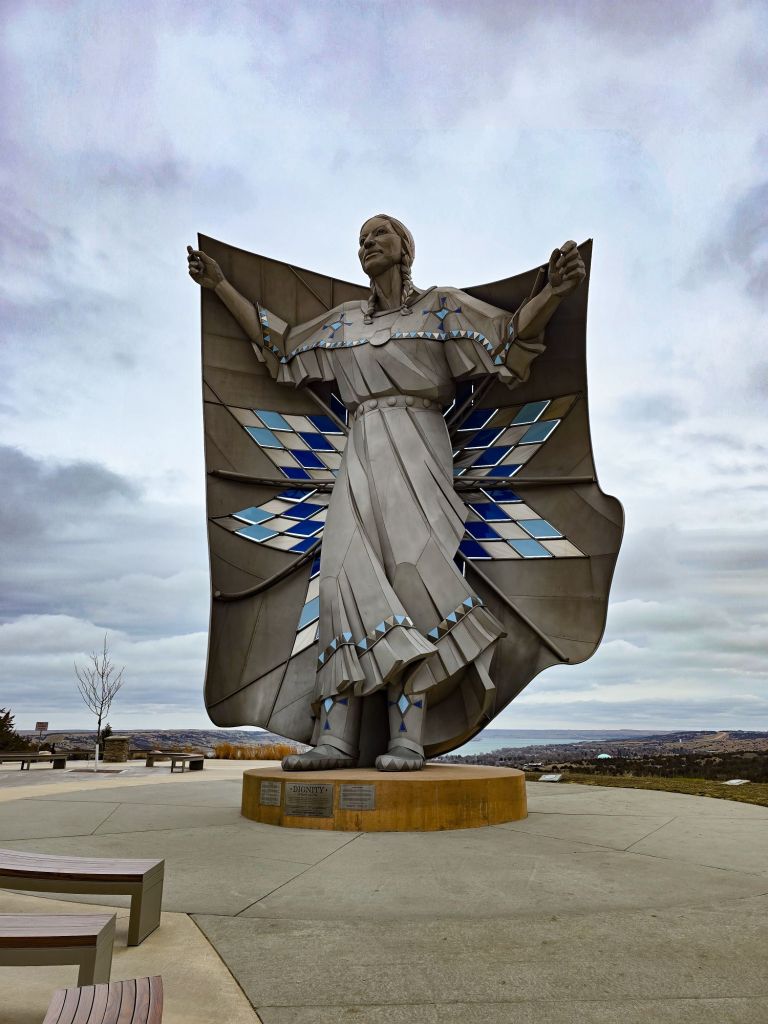
She Stands Between Prairie and Hills

There’s a moment, right before the land changes, where I always pull over.

East of the river, everything stretches—flat, open, familiar. Prairie that feels like it goes on forever, like a breath you don’t have to think about taking. But once you cross the Missouri, the earth begins to rise. It gathers itself into hills, into movement, into something a little more wild.

And right there, in that in-between, she stands.

Lady Dignity.

She doesn’t just stand—she holds space. Arms outstretched, star quilt open like a sky you can almost step into. She stands with her back to the Missouri River, facing east—toward the prairie, toward the long stretch of land I come from.

There’s something about that I can’t shake.

It feels intentional. Like she isn’t watching what has passed, but what is still becoming. Like she’s holding space for what lies ahead instead of what’s already behind.

And every time I stop there, coming from the east, it feels like she’s meeting me. Not turning away—but standing firm, steady, facing the same horizon I’ve known my whole life.

Prairie to prairie. Quiet to quiet.

Like she understands where I’ve been before I even arrive.

I always stop here. I don’t rush it. I don’t treat it like just another roadside landmark. It feels wrong to do that.
There’s something about her that asks for stillness.

Maybe it’s the way the wind moves through this place—real South Dakota wind, the kind that doesn’t ask permission. It catches the edges of her quilt, the blues shifting like pieces of sky caught in motion. In the daylight, those diamond shapes flicker and glow, like quiet reminders that even something solid can carry light.

And at night, she changes.

She doesn’t disappear into the dark—she rises in it. Lit up, steady, unwavering. Not softer, not smaller. Just… present in a different way. Like strength doesn’t always have to be loud to be seen.

Dale Lamphere said she represents the courage, perseverance, and wisdom of the Lakota and Dakota people—and you can feel that when you stand there. Not in a loud, overwhelming way. But in something deeper. Something rooted. Something that doesn’t need to prove itself to be known.

It makes you straighten a little. Look a little longer. Think a little quieter.

For me, she’s become a marker. Not just of geography—east and west, prairie and hills—but of something internal too. A pause between where I’ve been and where I’m going. A reminder that there’s strength in standing still for a moment. In acknowledging the ground beneath you and the history it holds.

Every time I stop, it feels the same and different all at once.

Familiar, like coming back to something that knows you.
And humbling, like you’re being gently reminded how small you are in the presence of something that carries so much more.

I don’t stay forever.

Just long enough to look up at her, to let the wind move around me, to feel that quiet settle in my chest.

And then I keep driving—west into the hills, or back east into the open.

But I carry her with me every time.

Because some places don’t just exist on a map.
Some places meet you where you are—and leave something behind when you go.

And she does.

She always does.

She Stands Between Prairie and Hills

There’s a moment, right before the land changes, where I always pull over.

East of the river, everything stretches—flat, open, familiar. Prairie that feels like it goes on forever, like a breath you don’t have to think about taking. But once you cross the Missouri, the earth begins to rise. It gathers itself into hills, into movement, into something a little more wild.

And right there, in that in-between, she stands.

Lady Dignity.

She doesn’t just stand—she holds space. Arms outstretched, star quilt open like a sky you can almost step into. She stands with her back to the Missouri River, facing east—toward the prairie, toward the long stretch of land I come from.

There’s something about that I can’t shake.

It feels intentional. Like she isn’t watching what has passed, but what is still becoming. Like she’s holding space for what lies ahead instead of what’s already behind.

And every time I stop there, coming from the east, it feels like she’s meeting me. Not turning away—but standing firm, steady, facing the same horizon I’ve known my whole life.

Prairie to prairie. Quiet to quiet.

Like she understands where I’ve been before I even arrive.

I always stop here. I don’t rush it. I don’t treat it like just another roadside landmark. It feels wrong to do that.
There’s something about her that asks for stillness.

Maybe it’s the way the wind moves through this place—real South Dakota wind, the kind that doesn’t ask permission. It catches the edges of her quilt, the blues shifting like pieces of sky caught in motion. In the daylight, those diamond shapes flicker and glow, like quiet reminders that even something solid can carry light.

And at night, she changes.

She doesn’t disappear into the dark—she rises in it. Lit up, steady, unwavering. Not softer, not smaller. Just… present in a different way. Like strength doesn’t always have to be loud to be seen.

Dale Lamphere said she represents the courage, perseverance, and wisdom of the Lakota and Dakota people—and you can feel that when you stand there. Not in a loud, overwhelming way. But in something deeper. Something rooted. Something that doesn’t need to prove itself to be known.

It makes you straighten a little. Look a little longer. Think a little quieter.

For me, she’s become a marker. Not just of geography—east and west, prairie and hills—but of something internal too. A pause between where I’ve been and where I’m going. A reminder that there’s strength in standing still for a moment. In acknowledging the ground beneath you and the history it holds.

Every time I stop, it feels the same and different all at once.

Familiar, like coming back to something that knows you.
And humbling, like you’re being gently reminded how small you are in the presence of something that carries so much more.

I don’t stay forever.

Just long enough to look up at her, to let the wind move around me, to feel that quiet settle in my chest.

And then I keep driving—west into the hills, or back east into the open.

But I carry her with me every time.

Because some places don’t just exist on a map.
Some places meet you where you are—and leave something behind when you go.

And she does.

She always does.