The Mountain Always Looked Different in Fall

Today is officially the first day of fall.

There are certain things I wait for every year without realizing just how much I have missed them. The first morning when the air feels different against my skin. The first evening when summer finally releases its grip and I can reach for a hoodie without regretting it. The first leaves that begin to turn, almost quietly, as though the trees are keeping a secret from the rest of the world.

Fall has always been my favorite season.

Maybe because I have always understood something about the beauty of things changing.

There is something about autumn that feels honest. Nothing stays green forever. Nothing holds its shape forever. The trees spend months growing, reaching, becoming, and then, when the time comes, they let go. They do not try to hold onto summer. They simply become something else.

And I think I have always loved that.

But when I think about fall, my mind does not first go to South Dakota.

It goes to the mountains.

It goes to Crossroads.

Fall at Crossroads was something I could never quite explain to someone who had not stood there and watched it happen. The mountains did not simply change color. They seemed to change entirely.

At first, it was subtle. One tree would begin turning at the edges, a little yellow or orange appearing among the green. Then another would follow. Every time you walked outside, something had changed. A different branch had turned. A different hillside had begun to glow.

And then, somehow, you would look up one day and realize the entire mountain had become autumn.

Red and orange and gold stretched across the hills as far as you could see. The trees seemed to catch fire beneath the afternoon sun, but there was nothing destructive about it. It was beautiful in the quietest, strangest way.

I could have stood there forever.

I loved the way the air changed when fall came to the mountain, too. It was still that familiar mountain air, clean and fresh, but there was a coolness woven through it now. Mornings felt sharper. Evenings came with a chill that made campfires feel necessary.

There were nights spent outside beneath the darkening sky, with smoke curling upward and sparks disappearing into the darkness. There were leaves scattered across the roads and paths, the sound of them beneath your feet, and mountains disappearing into shadow as the sun went down.

It felt like the whole place was breathing differently.

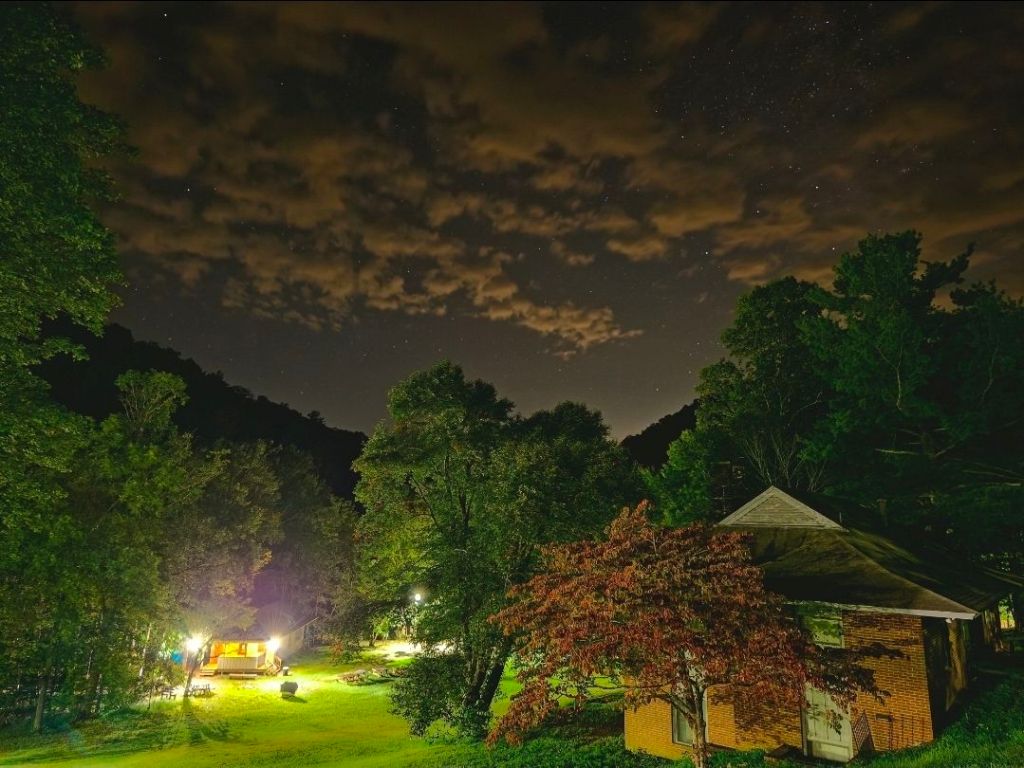
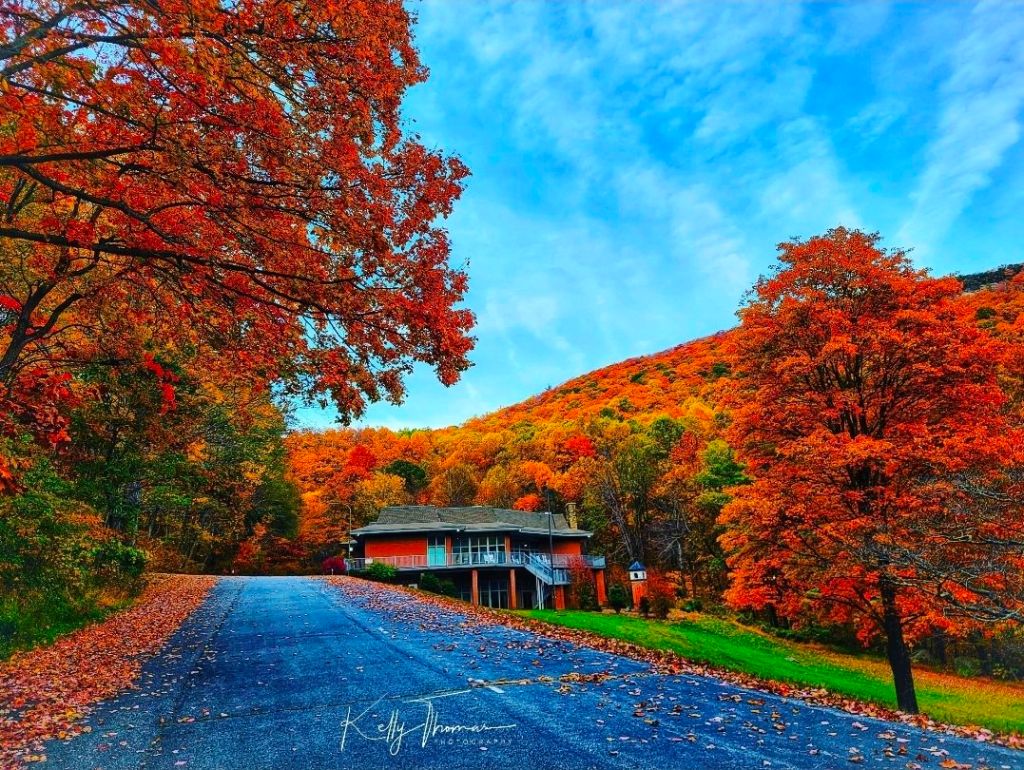
And now, looking at this photograph, I realize how much I miss it.

Not just the colors.

Not just the mountains.

I miss the feeling of being there.

I miss knowing that I could turn a corner and suddenly find myself surrounded by more beauty than I knew what to do with. I miss looking up at those mountains and watching the season move across them. I miss the cool air and the smell of woodsmoke. I miss the way autumn seemed to settle over Crossroads and make everything feel a little more alive.

There are places that become tangled up with pieces of who we are.

You leave them, but you do not really leave them.

They stay in photographs. They stay in memories. They hide in certain songs, certain smells, certain kinds of weather. They come back when the leaves begin to change and you suddenly find yourself remembering a road you have not driven in years.

Crossroads is one of those places for me.

And perhaps that is why this photograph feels like more than a photograph.

It is a road covered in fallen leaves.

It is a building beneath the mountain.

It is a sky I remember.

It is a season I loved.

It is a place I miss.

I know fall will keep coming whether I am standing on that mountain or watching the seasons change here at home. The world will keep turning gold. Leaves will still fall. The evenings will still grow cold. Somewhere, someone will light a campfire beneath an October sky.

But there will always be a part of me that remembers what autumn looked like at Crossroads.

There will always be a part of me standing somewhere on that mountain, looking out at all those colors and thinking, I wish I could keep this.

Maybe that is why I take photographs.

Because I know nothing stays.

The leaves fall. The seasons move on. Places change. People leave. Years pass.

So I take the picture.

I keep a little piece of the moment where I found it.

And every September, when the air begins to cool and the first hints of autumn return, I find myself thinking about that mountain again.

I miss it.

I miss Crossroads.

And I think I will always miss fall there most of all.

Happy First Day of Fall! 🍂
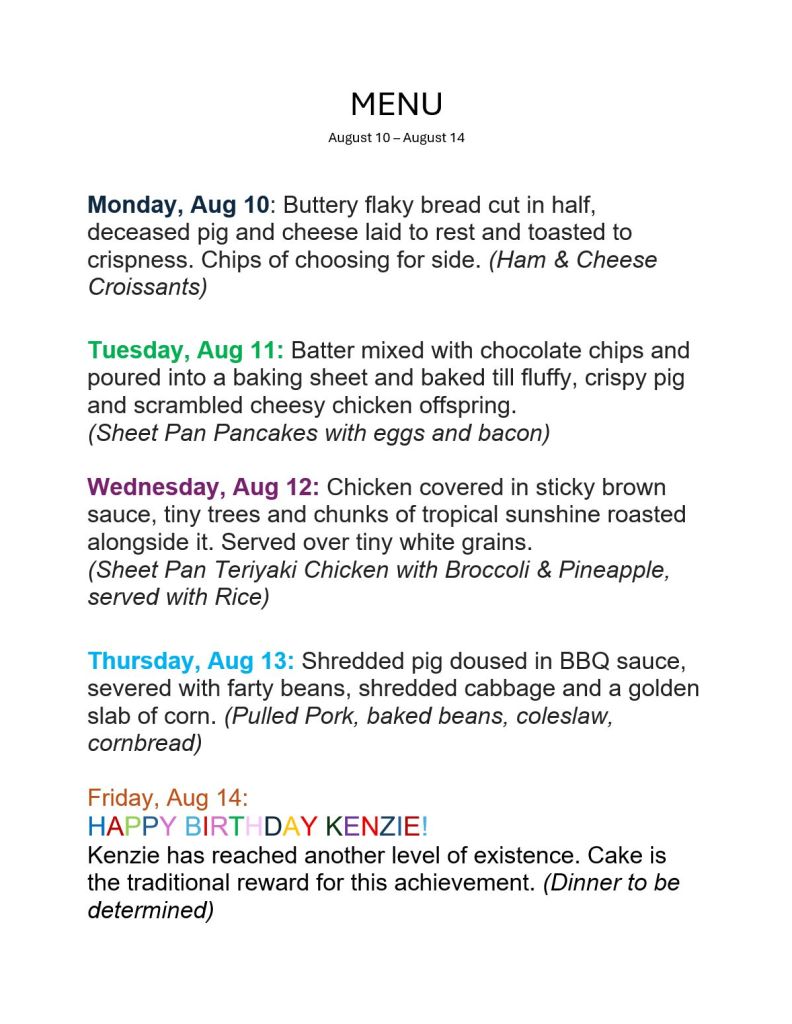
What’s for Dinner?

Most weekdays, I cook dinner.

There are exceptions, of course. Some nights Stouffer’s grandma’s rice and chicken comes out of the freezer because, honestly, it’s delicious. Sometimes Pizza Hut or Jimmy John’s gets picked up. Not every evening needs to end with me standing in the kitchen pretending I have unlimited time and energy.

But most Monday through Friday evenings, I cook.

And because apparently cooking dinner wasn’t enough, I also make a menu for the week.

There is actually a surprising amount that goes into deciding what goes on it. I look at the weather, the farm chores, what the kids have going on with school and gymnastics, and how much running around we are going to be doing. A meal that sounds perfectly reasonable on Sunday can suddenly seem like a terrible idea when I realize Tuesday is going to be one of those days.

I also try to make at least one new recipe every week.

That one is always a bit of a gamble. Sometimes we find something that everyone likes and it gets added to the rotation. Other times, we discover that the recipe sounded considerably better on paper.

Those are the meals that get promoted to Bowl of Sadness.

A Bowl of Sadness is not made again.

We don’t revisit it. We don’t convince ourselves that maybe we just did something wrong. We eat it, acknowledge the mistake, and quietly move on with our lives.

Thankfully, there are more successes than Bowls of Sadness.

And then there are the menus themselves.

I like making them, but I apparently cannot make a normal one. I have to give the food ridiculous descriptions, usually with far more drama than the meal deserves. It has become one of those little things I do for the family, and now they expect to see what nonsense I have come up with for the week.

This week’s menu is a pretty good example.

I am already thinking about next week’s.

I’m considering going medieval.

I don’t entirely know what that means yet, but I feel like I have already committed to the idea. There may be feasts. There may be peasants. There will almost certainly be an unnecessarily dramatic description of whatever pork happens to be on the menu.

And honestly, I kind of love that this has become a thing.

Dinner is still just dinner. Some nights it is something I have made a hundred times, some nights it is a new recipe that turns out to be wonderful, and every once in a while it is a Bowl of Sadness that will never see the kitchen again.

But somewhere between the farm chores, the weather, the kids’ schedules, and figuring out what I can realistically make that week, I get to put a little bit of my personality on the refrigerator.

Even if that personality apparently involves declaring a ham sandwich to be a deceased pig.

The Weight of a Name

I have ADHD, which means my mind has never been very good at leaving things alone.

It catches on the smallest details, things most people probably wouldn’t give a second thought to, and before I know it I’ve spent an hour turning one little idea over and over in my head. It’s why I end up wondering why some places feel like home long after you’ve left them, why certain songs can carry entire years inside of them, or why a single photograph can make your chest ache in a way you can’t quite explain.

This time, it was titles.

Not the kind you put on a résumé or a business card, but the ones we give each other. Friend. Best friend. Brother. Sister. Family.

The more I thought about them, the more one word refused to leave me alone.

Friend.

Maybe it’s strange to spend this much time thinking about a single word. Then again, I’ve never really believed words were just words. They’ve always felt heavier than that to me. They carry memories. Promises. Expectations. Sometimes they carry grief. Sometimes they carry home. A word can become so intertwined with a person that hearing it years later still brings them to mind.

That’s why I think so much about them.

Lately, I’ve realized something that surprised me.

I think I’d rather be called a friend than a best friend.

Not because I don’t value the people closest to me. Quite the opposite, actually.

It’s because I’ve started wondering if we’ve made “best friend” so common that it’s begun to lose some of the weight it once had. It’s everywhere now. Captions, conversations, introductions, birthday posts. It has become the default way of telling someone they’re important to us. Maybe that’s enough for most people, and I don’t think there’s anything wrong with that. This isn’t me saying people shouldn’t use it.

I just don’t think it’s ever been the word that meant the most to me.

I’ve never really understood why friendship became something we rank.

Maybe that’s human nature. We like putting things into neat little categories. First place. Second place. Best. Favorite. Closest. We do it with books, movies, songs, restaurants, photographs. We like lists because they make the world feel organized.

But people have never felt like lists to me.

Every friendship has asked something different of me. Every person has walked into my life carrying different joys, different wounds, different stories. Some friendships have been loud and adventurous. Others have been built almost entirely on quiet conversations and comfortable silence. Some lasted only a season but changed me forever. Others have quietly stretched across years, surviving distance, changing schedules, different versions of ourselves, and all the ordinary ways life slowly rearranges people.

How do you rank something like that?

How do you decide which friend mattered more?

The one who sat beside you during the darkest season of your life?

The one who reminds you to laugh when you’ve forgotten how?

The one who lives hundreds of miles away but still feels strangely close?

The one who understands your silence well enough to know it doesn’t always need to be filled?

I don’t think I could.

Maybe that’s why the word friend has always sounded complete to me. It has never felt like a title waiting for another word to make it more important.

If anything, I think we’ve forgotten how beautiful friendship actually is.

There are very few relationships where the only thing keeping two people together is their continued desire to know one another. Friendship is one of them, and I think that’s part of what makes it so extraordinary. Every day, without ever talking about it, we simply decide whether we’ll continue making room for another person in our lives.

That feels sacred to me.

Maybe it’s because I’ve watched how easily life changes people.

I’ve watched friends move away.

I’ve watched careers consume time that used to belong to conversations.

I’ve watched marriages, children, grief, illness, loss, and distance reshape lives in ways no one could have predicted.

I’ve learned that loving someone doesn’t guarantee you’ll always walk beside them. Sometimes life simply carries people in different directions, no matter how much they wish it wouldn’t.

Maybe that’s why I value the ones who continue choosing each other.

Not perfectly.

Not constantly.

Just… consistently.

I don’t think friendship is measured by how often you see each other or how quickly someone replies to a message. Life gets busy. People become overwhelmed. Seasons change. The older I get, the more grace I find myself wanting to give the people I love.

Instead, I think friendship is measured in quieter ways.

It’s remembering.

It’s continuing to reach for someone after months have slipped by.

It’s learning how someone changes without expecting them to stay exactly the same.

It’s making room for the person they’re becoming instead of mourning the person they used to be.

It’s believing a relationship is worth tending to, even when life doesn’t make it easy.

Those things don’t usually come with announcements.

Most people will never notice them.

But I think that’s where friendship quietly lives.

Maybe that’s why titles matter less to me now than they used to.

When I think about the people I treasure most, I don’t think about what we’ve called each other over the years. I think about the roads we’ve walked together. I think about the conversations that lasted long after the sun disappeared. I think about the moments one of us needed someone, and the other simply showed up. I think about all the ordinary days that seemed insignificant while we were living them, only to realize later they had become the memories we missed the most.

That’s what gives a title its weight.

Not the word itself.

Everything that came before it.

So if you ever introduce me as your friend, I don’t think I’ll hear something smaller than “best friend.”

I’ll hear years.

I’ll hear trust.

I’ll hear every ordinary Tuesday that slowly became a lifetime of knowing another human being.

Because to me, friendship has never been an ordinary thing.

It’s one person looking at another in a world where everyone is constantly changing, constantly moving, constantly leaving pieces of themselves behind, and quietly deciding,

“I’d still like to keep knowing you.”

I don’t know if there’s a greater compliment than that.

Part 1: When Love Isn’t Enough to Stay

This is the first of several reflections on the eleven years I spent at camp, the people who shaped them, and what it means to leave a place that will always feel a little like home.
•
I don’t think anyone prepares you for the grief that comes from leaving something you still love.

We’re taught to expect grief after death. After divorce. After losing a job or saying goodbye to someone we’ve known for years. Those losses make sense to people. They have names. They have rituals. They have casseroles and sympathy cards and conversations that begin with, “I’m so sorry.”

But what do you call the ache that comes from willingly walking away from a place that shaped you?

What do you call the kind of grief that comes from making the right decision, while wishing with every part of you that it hadn’t been necessary?

I’ve asked myself those questions more times than I can count over the past few months.

When people hear that I left camp, the response is usually simple.

“Well… you chose to leave.”

They’re right.

I did.

But I wish people understood that choosing something doesn’t make it painless.

Sometimes the deepest grief is born from the decisions we make with clear eyes. Decisions that aren’t made because love disappeared, but because somewhere along the way, you realized that love alone couldn’t carry what had become too heavy.

I spent eleven years at camp.

Eleven years is long enough for a place to stop feeling like a destination and start feeling like part of your identity.

It became woven into the rhythm of my life so quietly that I never noticed it happening. Summers were measured by staff week and closing day. My calendar bent around retreats and work weekends. I could drive those mountain roads without thinking because my hands had learned every curve before my mind ever had.

Home stopped being an address.

Sometimes it was a gravel road disappearing into the Blue Ridge Mountains.

People ask what I miss, and I never know how to answer.

I could tell them I miss the mountains, and that would be true.

I could tell them I miss hearing laughter echo across camp after the sun went down, or watching the valley disappear beneath morning fog, or the familiar sound of screen doors slamming all summer long.

That would all be true too.

But those aren’t the things that wake me up missing camp.

What I miss is harder to explain.

I miss the certainty.

I miss belonging somewhere so completely that I never questioned whether there was a place for me there.

I miss believing that there would always be another summer.

There is something quietly heartbreaking about discovering that a chapter of your life has ended before your heart has caught up to it.

Your mind knows you’ve left.

Your feet know you don’t drive that road anymore.

But your heart still keeps reaching for something that no longer belongs to your present.

People don’t always understand that kind of grief.

Maybe because the place is still there.

Camp didn’t disappear.

The cabins are still standing.

The campfires are still being lit.

Someone else is making memories in the spaces where mine were made.

Life continued exactly as it was supposed to.

It just continued without me.

I think that’s what has made this loss feel so isolating.

When someone dies, everyone grieves together.

When you leave a place, the world rarely notices.

It doesn’t pause.

It doesn’t ask how you’re doing months later.

It simply expects you to find something else and keep moving.

Maybe I will.

Maybe, someday, another place will feel like home.

But I don’t think that diminishes what camp was.

For eleven years, it held versions of me that no longer exist.

The eager twenty-something who thought she had forever.

The exhausted staff member who ran on coffee and purpose.

The woman who celebrated victories, carried disappointments, cried in quiet places where no one could see, laughed until she couldn’t breathe, and kept showing up because she believed the work mattered.

Those versions of me are still there somehow.

Scattered across those mountains like forgotten wildflowers.

Sometimes I wonder if that’s why leaving hurt so much.

It wasn’t because I was walking away from a place.

It was because I was saying goodbye to every version of myself that had been loved, stretched, broken, healed, and changed there.

People say you can’t go back.

They’re right.

Even if I drove through those gates tomorrow, I couldn’t return to the camp I’m grieving.

Because the place I’m missing isn’t only made of cabins and trails.

It’s made of moments.

Of people.

Of seasons.

Of a younger version of myself who had no idea that one day she’d have to learn how to love a place from a distance.

Maybe that’s what grief really asks of us.

Not to forget.

Not to move on.

But to carry what was beautiful without asking it to become what it used to be.

I’m still learning how to do that.

Some days I do it well.

Other days, I still find myself looking toward the mountains, missing a place that gave me eleven years… and wondering if somewhere, in ways I’ll never fully understand, it is still holding pieces of me too.

The Sky Did Not Choose

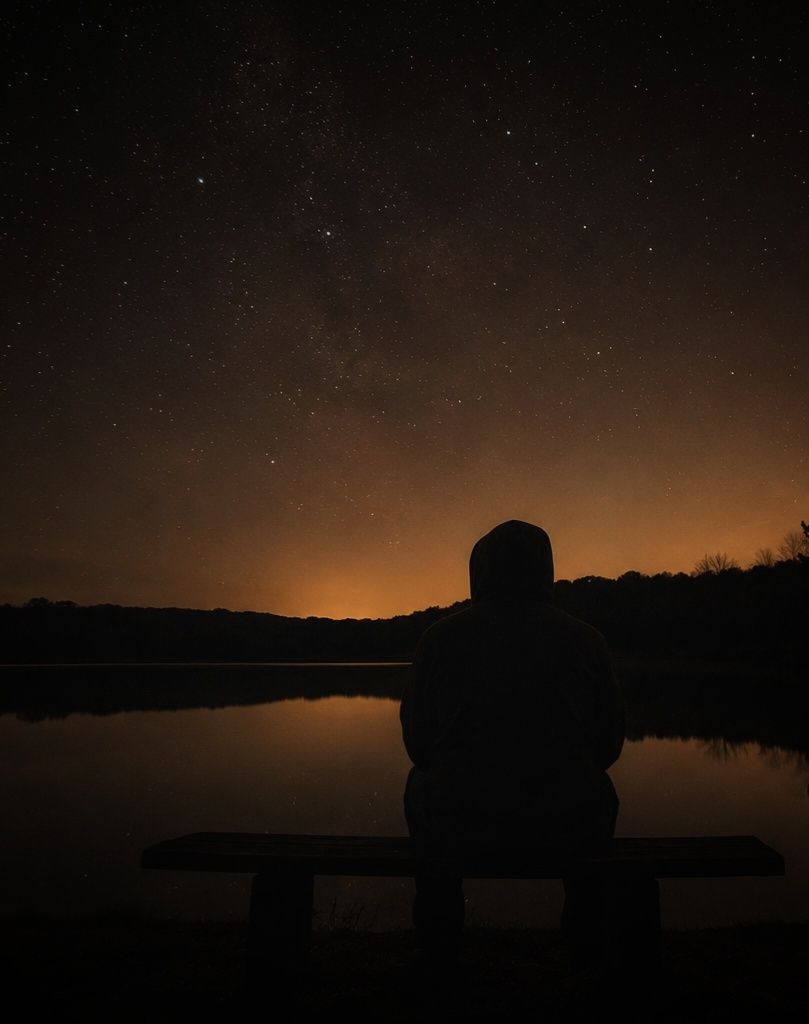
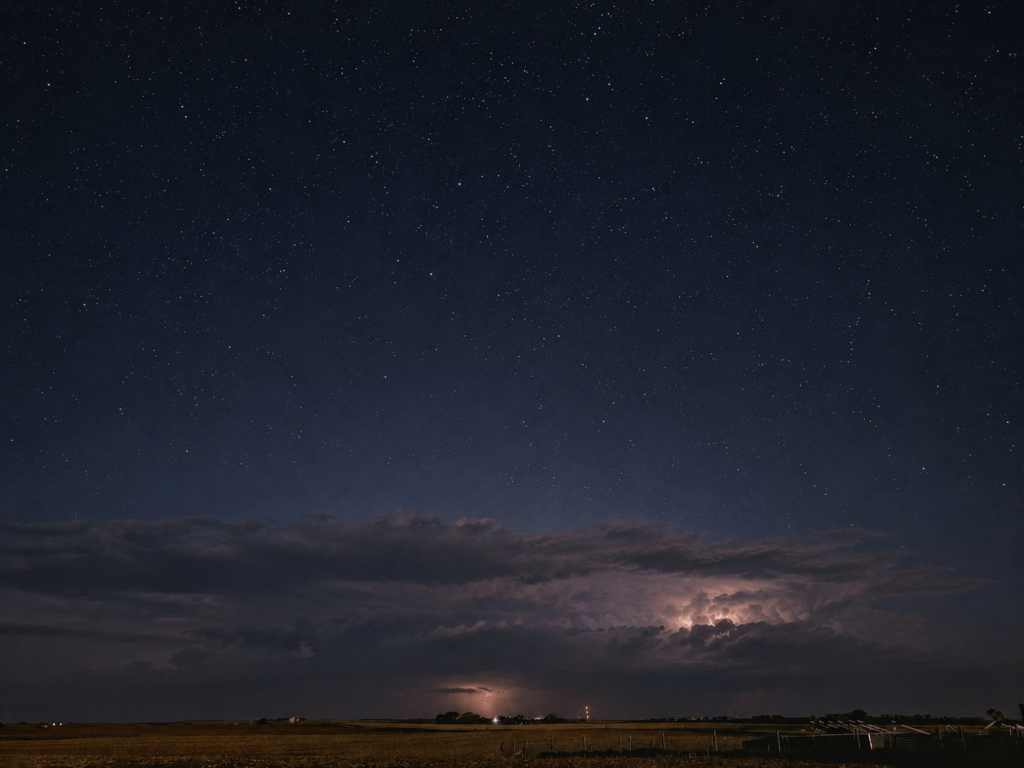
I sat outside
while lightning flickered through the clouds
in soft silver veins,
the kind that never touch the ground
but still make the whole sky feel alive.

The air was warm from the day,
but the wind had started turning cool,
moving through the fields and against my skin
like the earth itself was exhaling.

Above the storm,
the stars stayed bright.
Steady. Unmoving.

And below them
the clouds kept flashing with distant power,
like some ancient battle was unfolding
just beyond the horizon.

It should have felt violent.
Instead, it felt holy.

As if heaven itself could hold
both chaos and peace
at the same time.

I could not stop looking at it —
the stars beside the storm,
the beauty beside the ruin,
the quiet beside the power.

Because the stars did not disappear for the lightning.
The sky did not choose between wonder and ruin.
It carried both.
It survived both.

And sitting there beneath it,
with the wind in my hair
and the storm glowing softly against the dark,
I think some part of me wanted to believe
that maybe I could too.

Not Everyone Who Leaves Stops Loving It

A friend recently sent me a letter about camp leadership and the expectations that come with it, and I think part of me has been grieving it ever since.

Not because it was new information. Not because it shocked me. But because it finally gave words to something I have carried quietly for years.

There is this unspoken thing at camp where people leave pieces of themselves behind long after they are gone. A certain laugh in the dining hall. A tradition they started. A way they made children feel safe. Some people become so deeply woven into camp that their absence never really feels like absence at all. They become stories people tell around campfires years later. Memories repeated so often they almost stop sounding human and start sounding holy.

And then someone new arrives.

Young. Nervous. Trying so hard.

And everyone expects them to somehow step perfectly into the shape of the person before them.

There’s something quietly cruel about being expected to carry a torch you were never taught how to hold.

At camp, leadership gets passed down like tradition. One person leaves, another steps in, and somehow everyone expects the next person to already know how to do it all. How to lead. How to comfort homesick kids. How to carry conflict gently. How to keep camp feeling magical while they themselves are exhausted. How to be dependable and cheerful and emotionally available every second of the day.

But confidence is not instinct. Leadership is not magic. And experience cannot be inherited through expectation alone.

Still, camp has this way of acting like it can.

And maybe the hardest part is that the comparisons rarely come from cruelty. Most of the time they come from love. Someone missing the people who raised them there. Someone remembering summers that meant everything to them. So they say things casually, never realizing how deeply those words land inside someone already struggling to feel enough.

“Well, so-and-so used to do it this way.”

“They were always really good at this.”

“Last year just felt different.”

And maybe they forget those people were once uncertain too.

Maybe they forget there was a time before they became “camp legends.” Before they knew how to lead chapel or calm a crying camper or hold everything together so naturally people thought they were born knowing how.

Because nobody remembers the becoming. Only the version that survived it.

And I think what broke a lot of us was trying to become whole beneath the weight of everyone else’s memories.

It was the feeling that no matter how much of ourselves we poured into camp, we were still standing in the shadow of people who had already become untouchable there. We gave everything we had to children and cabins and traditions while quietly wondering if anyone could tell we had no idea what we were doing.

I think about the versions of us sitting awake after lights out, emotionally hollowed out from giving all day long. Smiling until our cheeks hurt. Holding crying children while privately feeling like we were falling apart too. Listening to worship songs in chapels while wondering why we suddenly felt so unbearably alone in a place full of people.

Because camp asks people to give in ways that are hard to explain to anyone who has never lived it.

It asks for your patience. Your energy. Your softness. Your joy. Your ability to stay calm when children are crying and schedules are collapsing and your body is begging you to rest.

And the terrifying thing is that so many of us were willing to give it everything.

We loved camp enough to ignore our own exhaustion. Enough to keep showing up while our mental health got worse. Enough to convince ourselves that struggling meant we were weak instead of overwhelmed. Enough to believe that if we just gave more of ourselves away, maybe eventually we would finally feel worthy of being there.

I think there are people who have not returned to camp in years who still carry guilt every single summer when the season comes around. People who see photos online and feel their chest ache with homesickness for a version of themselves that no longer exists. People who miss camp so deeply it feels like grief, but also know going back would reopen wounds they barely survived the first time.

And that is such a confusing kind of heartbreak. To love something so much and still need distance from it. To miss a place while also recognizing it slowly consumed you. To realize the place that once made you feel most alive also taught you, quietly and over time, that your worth depended on how much of yourself you were willing to sacrifice for everyone else.

I do not think camp means to hurt people.

I think camp is made of beautiful, exhausted humans trying to recreate the magic they once survived themselves.

But sometimes that means the cycle repeats.

Young leaders arrive wanting desperately to belong, and before they have even figured out who they are, they are handed emotional responsibilities too heavy for their shoulders and expectations too large for their still-forming hearts. They learn quickly that the people who are loved most at camp are the ones who give the most. The ones who stay latest. Work hardest. Need least. Smile anyway.

And some of us did that until there was almost nothing left of ourselves outside of camp at all.

Not everyone who leaves camp stops loving it.

Some of us just finally realized we were disappearing there, and stepping away was the first time we chose to save ourselves instead of sacrificing ourselves for a place that taught us exhaustion was the same thing as devotion.

The Sky Is Still Worth It

I was setting bowls down for the cats, just moving through one of those slow, slightly off days that come after being sick. Not bad enough to stop everything, just enough to make it all feel a little distant, like I was a step behind my own life.

They circled my legs, impatient and steady, completely present in a way I wasn’t.

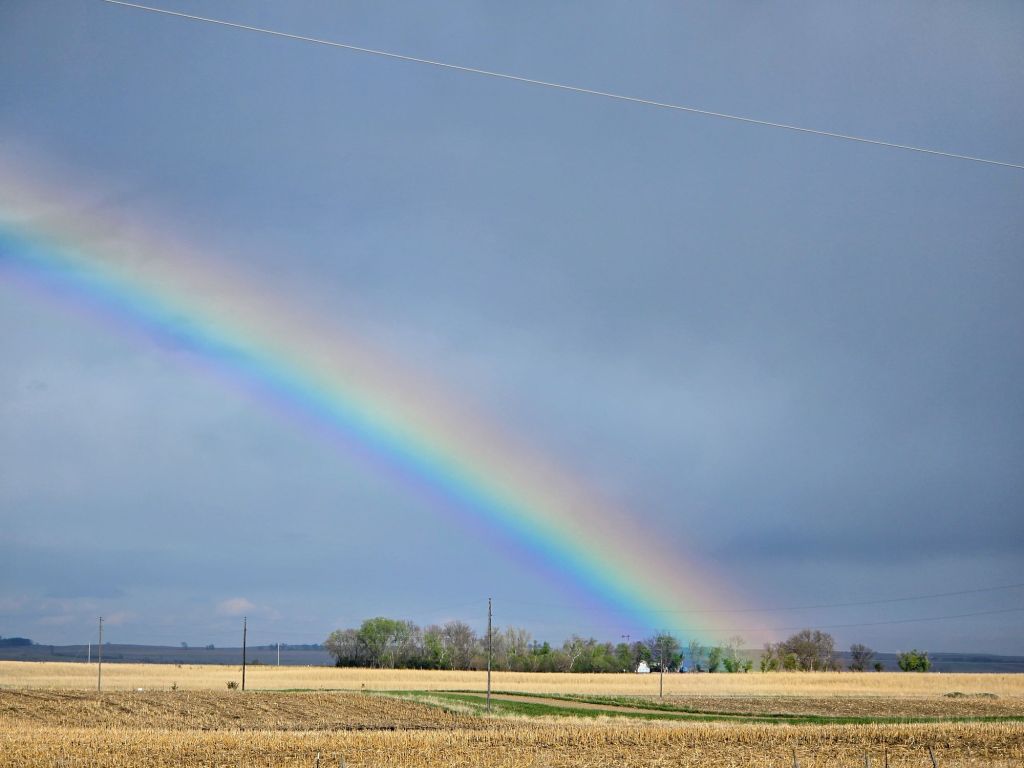
I glanced out the garage door and there it was.

A rainbow stretched wide across the sky like it had been waiting for someone to notice.

And I did what I always do. I stopped.

Because I am the kind of person who chases these things. The sky, the storms, the quiet moments most people pass by. I have stood in fields for stars, driven back roads for light, waited at the edge of days just to catch something fleeting before it disappears.

That part of me hasn’t gone anywhere.

Even sick, even tired, even a little disconnected, I still feel it. That pull. That instinct to look, to notice, to hold onto something beautiful for just a second longer.

I finished setting the bowls down faster than I meant to and went inside.

“Hey, come look.”

She’s four, so she ran like it mattered. Like wonder is something you have to meet halfway or you’ll miss it.

Her hands pressed against the window, her whole face lighting up in a way that felt familiar.

“A rainbow! Aunt Kelly, it’s a rainbow!”

And then, like it was the most obvious truth in the world,
“There’s a pot of gold at the end.”

And I smiled, because I understood her more than she realized.

Not the gold.
But the chase.

Because that’s what it is.

Not just seeing something beautiful, but believing there is something worth moving toward because of it.

I don’t believe there is a literal pot of gold waiting at the end of a rainbow.

But I do believe in standing in the cold for stars.
In chasing storms across open land.
In pulling over on gravel roads because the sky decided to become something more for a few minutes.

I believe in going after wonder like it might slip through your fingers if you don’t.

Standing there, still not fully myself, still carrying that quiet weight of the last few days, I realized something.

Wonder didn’t feel smaller.

It just felt a little further away in that moment.

But it was still mine.

Still there in the way I stopped.
Still there in the way I looked.
Still there in the part of me that will always turn toward the sky.

She saw a pot of gold waiting.

I saw something just as real.

A reason to keep chasing.

So remember to follow it.
Not just to notice the beauty, but to move toward it.
To step outside, to look longer, to go a little further than you need to.

Because wonder isn’t something you either have or lose.

It is something you choose, again and again, every time you decide the sky is worth looking at.

Journal Entry 01

Dear Journal,

I think the ache has a shape now.
Not sharp, not sudden, but something that settles in the space between noticing
and reaching.

Because the day fills anyway.

It fills with small, vivid things,
a market humming like it always has,
fruit warm in my hands,
voices passing close enough to feel like belonging.
And all day I move through it
with this quiet instinct
to turn, to say,

you wouldn’t believe this.

But there is no turning.

There is no name that rises naturally,
no number I don’t have to think twice about,
no voice waiting on the other end
of something as simple as
hey, are you busy?

And it changes the way everything lands.

The sunset still opens wide,
color spilling over itself like it cannot be contained,
clouds holding their shape just long enough
to feel intentional.
And I stand there,
heart already mid sentence,

you should see this, it’s unreal

but the sentence has nowhere to go.
It just stays.
Inside me.

The flowers along the roadside,
small, unnoticed, still leaning into light
like they trust it will be there.
I wanted to tell you
they felt like something steady,
like quiet survival.

I wanted to say
they reminded me of you.

But there is no one to call
to say things like that anymore.

And it is not the big moments that undo me,
it is this.

A candle I found that turns into soil after it burns,
something meant to end
and then begin again.
I stood there longer than I should have,
thinking how badly I wanted to share that,
not because it is extraordinary,
but because it meant something
in a way I cannot quite carry alone.

The wind came through warm,
threaded with dirt,
like the earth was close,
like everything was trying to be felt,

and I had no one to say,
do you feel that too?

That is what this is.

Not just being alone,
but having a life that keeps unfolding
in ways that ask to be spoken aloud,
and no one to speak it to.

No one to call
just to say nothing important.
No one to interrupt with small details,
no one to laugh about something that did not matter
until it did.

Just this constant collecting,
moments stacking quietly inside me,
soft, beautiful,
and heavier every day.

I do not think I am asking for much.

Just a voice
that feels natural to reach for.

Just someone
who exists on the other end of the ordinary,
who would answer,
not because it is urgent,

but because it is me.

Until then,
everything I would have said
settles here instead,

a life full of things worth sharing,
learning how to live

with no one to call.

The Sky Wouldn’t Wait

I almost stayed inside.

That’s what sits with me now, more than anything else. How easy it would have been to just watch it through the window. To notice the color, call it beautiful, and let it pass without asking anything of me.

But the sky didn’t look like something you could witness halfway.

It looked like it was breaking open.

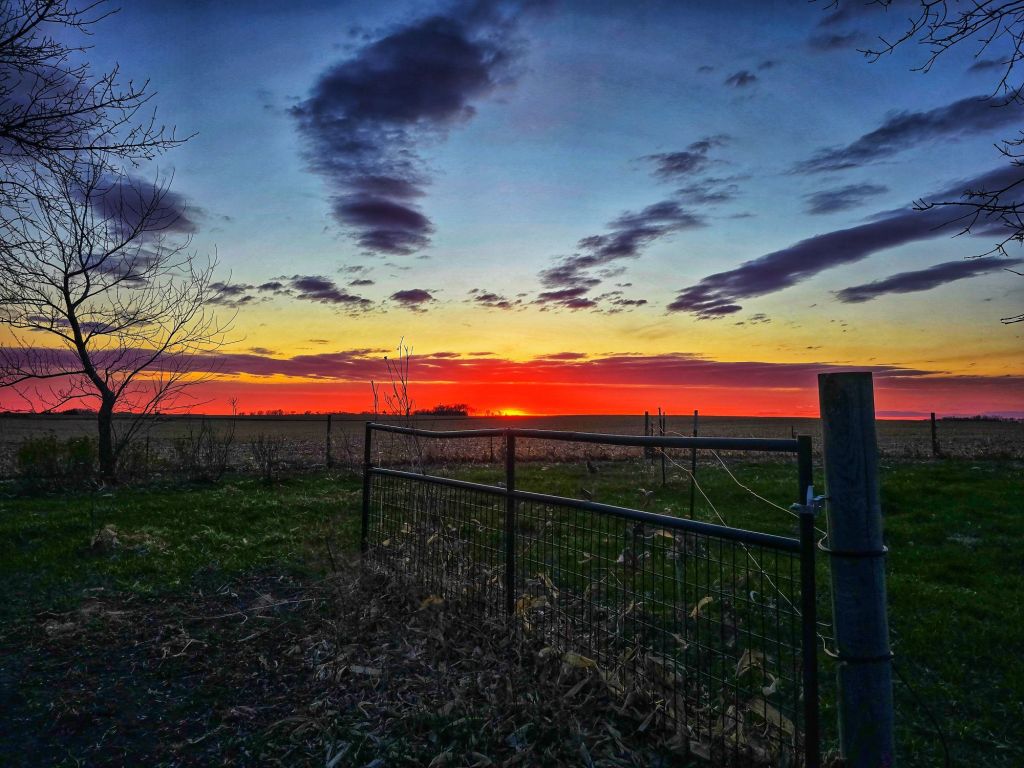
A thin line of fire at the horizon, orange deepening into red, red slipping into purple, like something alive and leaving at the same time. And there was this pull, quiet but certain, the kind that doesn’t wait for you to feel ready.

So I went.

Not prepared, not thought out. Just… as I was. The kind of leaving where you don’t stop to fix anything. Crocs shoved on without thinking, basketball shorts that made no sense for the cold, a thin hoodie that felt like a half-promise against 22 degrees.

I felt it the second I stepped outside.

The cold didn’t ease in. It took hold. Straight to my lungs, sharp enough to steal a breath and make me question it for a second. Just a second.

Because the sky was still burning.

So I ran.

Out into the back field, where the ground never quite holds you steady. Tall grass hiding every uneven step, fallen limbs waiting where you don’t see them. My shoes slipping just enough to remind me they weren’t meant for this, my legs stinging with cold that had nowhere to hide against bare skin.

I ducked under fencing that caught at my sleeves, pushed through lilac branches that scratched like they were trying to slow me down, like everything around me was asking if I was sure.

The wind met me head-on.

Thirty miles an hour of resistance, pressing into me, turning every step into effort. It felt almost intentional, like something trying to turn me back toward warmth, toward sense, toward staying.

And I didn’t have a good reason not to.

Just a knowing.

That if I stopped, if I hesitated, I would miss it.

And that felt heavier than the cold.

So I kept going, breath uneven, hands starting to go numb, hoodie doing nothing but reminding me how unready I was for this. Everything about me mismatched to the moment, like I had stepped out of one world and into another without warning.

But maybe that’s what it is.

The best moments don’t wait for you to match them.

They just happen.

By the time I reached the fence line, I wasn’t really running anymore. Just moving forward because I had already come this far, because turning back then would have meant carrying something I didn’t want to carry.

And then I saw it.

The horizon wide and open, nothing in the way. The sun slipping under like it was being pulled down, leaving everything behind in color. Orange into red into purple, folding into each other like they knew they didn’t have long.

The fence stood in front of me, steady, unmoving. The trees reached in from the sides, bare and quiet, like they were holding the moment in place.

And the sky just gave everything.

Not carefully. Not slowly.

It burned.

And I stood there in Crocs half-soaked from the grass, legs bare to the cold, a hoodie that never stood a chance, shaking from the wind and the weight of having made it there in time.

Not comfortable. Not steady.

But there.

And something in me settled in a way I don’t know how to explain cleanly.

That some things will never meet you where you are. They won’t wait for you to be ready, or warm, or dressed for it. They will exist fully without you.

And you either go to them, or you don’t.

I stayed until it faded. Until the colors softened, until the fire cooled, until the sky folded back into something quieter, like nothing had happened at all.

And the whole walk back, colder than before, slower now, I kept thinking about how close I came to missing it.

How easily this could have been a moment I only half-saw.

I think that’s what I’m trying to fight, in my own quiet way.

The version of me that stays inside.
That chooses comfort without question.
That lets things pass because they are inconvenient.

Because tonight, it was inconvenient.

And still, it mattered.

Not because it changed anything. Not because it fixed anything.

But because I was there.

Because I chose to step out into something I wasn’t ready for
to meet something that wouldn’t wait.

And maybe that’s enough.

Maybe that’s the whole point.

To keep going when something calls,
even if you’re underdressed,
even if you’re shaking,
even if it doesn’t make sense.

To meet the moment where it is,
not where it’s easy.

Because some things only exist out there,
past the fence line,
in the cold,
in the wind,
in the seconds before they disappear.

And I don’t want to keep missing them.

She Stands Between Prairie and Hills

There’s a moment, right before the land changes, where I always pull over.

East of the river, everything stretches—flat, open, familiar. Prairie that feels like it goes on forever, like a breath you don’t have to think about taking. But once you cross the Missouri, the earth begins to rise. It gathers itself into hills, into movement, into something a little more wild.

And right there, in that in-between, she stands.

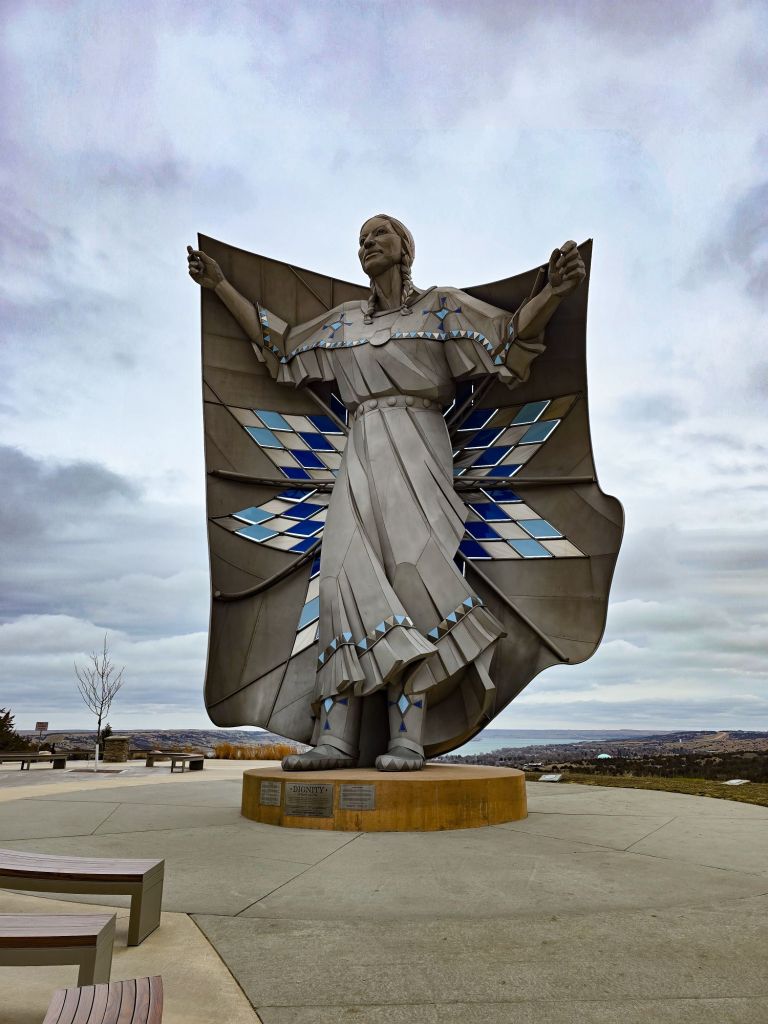
Lady Dignity.

She doesn’t just stand—she holds space. Arms outstretched, star quilt open like a sky you can almost step into. She stands with her back to the Missouri River, facing east—toward the prairie, toward the long stretch of land I come from.

There’s something about that I can’t shake.

It feels intentional. Like she isn’t watching what has passed, but what is still becoming. Like she’s holding space for what lies ahead instead of what’s already behind.

And every time I stop there, coming from the east, it feels like she’s meeting me. Not turning away—but standing firm, steady, facing the same horizon I’ve known my whole life.

Prairie to prairie. Quiet to quiet.

Like she understands where I’ve been before I even arrive.

I always stop here. I don’t rush it. I don’t treat it like just another roadside landmark. It feels wrong to do that.
There’s something about her that asks for stillness.

Maybe it’s the way the wind moves through this place—real South Dakota wind, the kind that doesn’t ask permission. It catches the edges of her quilt, the blues shifting like pieces of sky caught in motion. In the daylight, those diamond shapes flicker and glow, like quiet reminders that even something solid can carry light.

And at night, she changes.

She doesn’t disappear into the dark—she rises in it. Lit up, steady, unwavering. Not softer, not smaller. Just… present in a different way. Like strength doesn’t always have to be loud to be seen.

Dale Lamphere said she represents the courage, perseverance, and wisdom of the Lakota and Dakota people—and you can feel that when you stand there. Not in a loud, overwhelming way. But in something deeper. Something rooted. Something that doesn’t need to prove itself to be known.

It makes you straighten a little. Look a little longer. Think a little quieter.

For me, she’s become a marker. Not just of geography—east and west, prairie and hills—but of something internal too. A pause between where I’ve been and where I’m going. A reminder that there’s strength in standing still for a moment. In acknowledging the ground beneath you and the history it holds.

Every time I stop, it feels the same and different all at once.

Familiar, like coming back to something that knows you.
And humbling, like you’re being gently reminded how small you are in the presence of something that carries so much more.

I don’t stay forever.

Just long enough to look up at her, to let the wind move around me, to feel that quiet settle in my chest.

And then I keep driving—west into the hills, or back east into the open.

But I carry her with me every time.

Because some places don’t just exist on a map.
Some places meet you where you are—and leave something behind when you go.

And she does.

She always does.